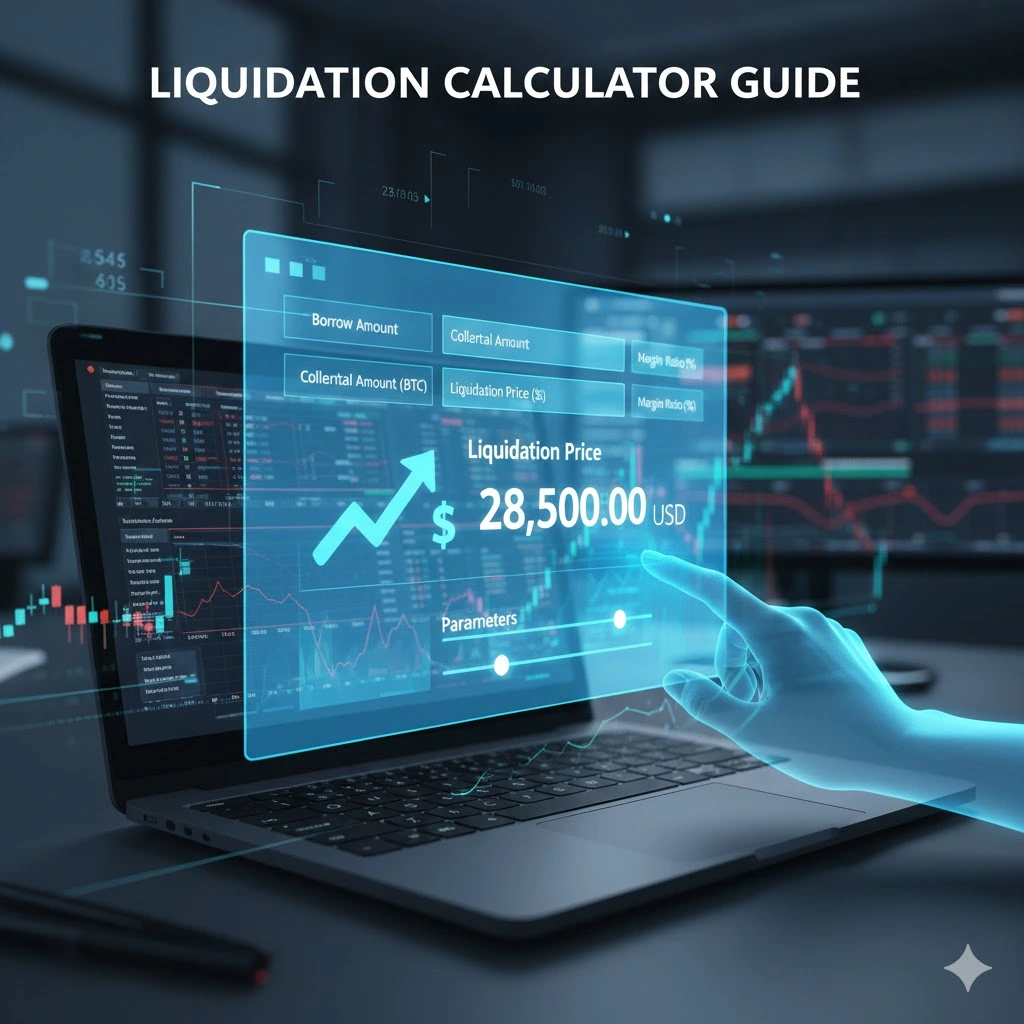
Trading crypto futures with leverage? One wrong move and you could lose everything. Before opening any leveraged position, you need to know exactly where your liquidation price is. Our Liquidation Calculator shows you the danger zone before you risk real money.
What is Liquidation in Crypto Trading?
Liquidation happens when your trading losses equal your margin (collateral). The exchange forcibly closes your position to prevent further losses — and you lose your entire margin.
How Liquidation Works: Step by Step
Let's walk through a real example:
You open a LONG position on Bitcoin:

Entry price: $100,000
Your margin: $1,000
Leverage: 10x
Position size: $10,000 (0.1 BTC)

What happens when price drops:

$99,000 (-1%): Unrealized loss = $100 (10% of margin)
$98,000 (-2%): Unrealized loss = $200 (20% of margin)
$95,000 (-5%): Unrealized loss = $500 (50% of margin)
$92,000 (-8%): Unrealized loss = $800 (80% of margin)
$90,000 (-10%): Unrealized loss = $1,000 (100% of margin)
                → LIQUIDATION! You lose $1,000
Calculate Your Liquidation Price
Don't guess — calculate. Use our free tool:
Liquidation Price Formula
For Long positions:
Liquidation Price = Entry Price × (1 - 1/Leverage + Maintenance Margin Rate)
For Short positions:
Liquidation Price = Entry Price × (1 + 1/Leverage - Maintenance Margin Rate)
Simplified (ignoring fees):
- Long 10x: Entry Price × 0.90 (liquidated at -10%)
- Short 10x: Entry Price × 1.10 (liquidated at +10%)
Liquidation Prices by Leverage Level
| Leverage | Long Liquidation | Short Liquidation | Room for Error |
|---|---|---|---|
| 2x | -50% from entry | +50% from entry | High |
| 3x | -33% from entry | +33% from entry | Moderate |
| 5x | -20% from entry | +20% from entry | Low |
| 10x | -10% from entry | +10% from entry | Very Low |
| 20x | -5% from entry | +5% from entry | Minimal |
| 50x | -2% from entry | +2% from entry | Almost None |
| 100x | -1% from entry | +1% from entry | None |
Bitcoin moves 5-10% daily. At 20x+ leverage, liquidation can happen in minutes.
Exchange-Specific Liquidation Rules
Binance Futures
| Account Type | Maintenance Margin | Liquidation Process |
|---|---|---|
| USDⓈ-M Futures | 0.4% - 5% (tiered) | Partial then full |
| COIN-M Futures | 0.5% - 5% (tiered) | Partial then full |
| Cross Margin | Uses entire balance | Higher liquidation price |
| Isolated Margin | Uses position margin only | Safer |
Binance Tip: Use Isolated Margin to limit losses to that position only.
Bybit
| Feature | Details |
|---|---|
| Maintenance Margin | 0.5% base + tiers |
| Insurance Fund | Covers bankrupt positions |
| ADL (Auto-Deleveraging) | If insurance depleted |
| Dual Price Mechanism | Fair price prevents manipulation |
Bybit Tip: Watch the liquidation risk indicator — it shows % distance to liquidation.
OKX
| Feature | Details |
|---|---|
| Maintenance Margin | Tiered by position size |
| Portfolio Margin | For advanced users |
| Mark Price | Used for liquidation (not last price) |
| Partial Liquidation | Reduces position before full liquidation |
5 Strategies to Avoid Liquidation
1. Use Lower Leverage
The simplest protection:
| Strategy | Leverage | Liquidation Distance |
|---|---|---|
| Aggressive | 20x-50x | 2-5% |
| Moderate | 5x-10x | 10-20% |
| Conservative | 2x-3x | 33-50% |
| Recommended | 3x-5x | 20-33% |
2. Always Set Stop-Losses
Rule: Stop-loss BEFORE liquidation price

Example (Long 10x at $100,000):
├── Liquidation price: $90,000
├── Set stop-loss at: $95,000
├── If hit: Lose 50% of margin
├── If not set: Lose 100% of margin
└── Capital preserved for next trade
Learn more: What is a Stop-Loss?
3. Use Isolated Margin
| Margin Type | On Liquidation | Risk Level |
|---|---|---|
| Isolated | Lose only that position's margin | Lower |
| Cross | Lose entire account balance | Higher |
Always use Isolated Margin unless you have a specific strategy requiring cross margin.
4. Size Your Positions Properly
The 1-2% Rule:
Never risk more than 1-2% of total capital per trade

Portfolio: $10,000
Max risk per trade: $100-$200
With 10x leverage: Max position $1,000-$2,000 margin
5. Monitor and Add Margin if Needed
If your position moves against you:
- Option A: Close at a loss (preserve capital)
- Option B: Add margin (increases risk but delays liquidation)
- Option C: Reduce position size (close part of it)
Warning: Option B (adding margin) can lead to throwing good money after bad.
Real Liquidation Examples
Example 1: Overleveraged Trader
Trader opens:
├── Long BTC at $100,000
├── Leverage: 50x
├── Margin: $1,000
├── Position: $50,000

What happens:
├── BTC drops 1.5% to $98,500
├── Loss: $750 (75% of margin)
├── BTC drops 2% to $98,000
├── LIQUIDATED
└── Result: Lost $1,000 in minutes
Example 2: Conservative Trader
Trader opens:
├── Long BTC at $100,000
├── Leverage: 3x
├── Margin: $1,000
├── Position: $3,000
├── Stop-loss at: $90,000

What happens:
├── BTC drops 10% to $90,000
├── Stop-loss triggered
├── Loss: $300 (30% of margin)
├── Capital remaining: $700
└── Result: Lives to trade another day
Example 3: Cascade Liquidation Event
Major market events can trigger cascading liquidations:
March 2020 COVID Crash:
├── BTC dropped 50% in 24 hours
├── $1.6 billion liquidated in one day
├── Cascade: Liquidations → selling → more liquidations
└── Many traders lost everything

May 2021 China Ban:
├── BTC dropped 30% in one day
├── $8 billion liquidated
└── Leverage traders wiped out

FTX Collapse 2022:
├── Mass liquidations across all exchanges
├── Billions in losses
└── Even "safe" positions liquidated
Margin Call vs Liquidation
Understanding the warning signs:
| Event | What Happens | What To Do |
|---|---|---|
| Margin Call | Exchange warns you're close to liquidation | Add margin or close position |
| Liquidation | Exchange closes your position | Nothing — it's too late |
Learn more: What is a Margin Call?
Why Most Leveraged Traders Lose Money
Statistics don't lie:
- 70-95% of retail traders lose money with leverage
- Average time from starting to blowing up: 3-6 months
- Most common mistake: Too much leverage, no stop-loss
The Safer Alternative: DCA Without Leverage
For most investors, Dollar-Cost Averaging (DCA) on spot markets is a better choice:
| Factor | Leveraged Trading | DCA on Spot |
|---|---|---|
| Liquidation risk | HIGH | ZERO |
| Maximum loss | 100% (instantly) | Only if asset → $0 |
| Stress level | Extreme | Low |
| Time required | 24/7 monitoring | 15 min/week |
| Historical results | 95% lose money | Positive for BTC holders |
Futures Trading
- Can lose 100% in minutes
- Requires constant monitoring
- High stress and emotional toll
- 95% of traders lose money
- Fees compound losses
DCA Strategy
- No liquidation risk ever
- Set it and forget it
- Low stress investing
- Historical positive returns
- Minimal fees
Calculate your DCA returns: DCA Calculator
FAQ
What leverage is safe for crypto trading?
There's no 'safe' leverage, but 2x-5x is considered conservative. At 10x+ leverage, even normal market volatility can liquidate you. Always calculate your liquidation price first.
How do I know when I'll be liquidated?
Use our Liquidation Calculator to find your exact liquidation price. Your exchange also shows your margin ratio and distance to liquidation in the positions panel.
Can I recover from a liquidation?
No. Once liquidated, your margin is gone. You need to deposit new funds to trade again. This is why protecting your positions with stop-losses is crucial.
Why did I get liquidated when the price didn't hit my liquidation price?
Exchanges use Mark Price (fair price) for liquidation, not Last Price. During high volatility, mark price can differ. Also, funding fees and trading fees reduce your margin over time.
Is isolated margin or cross margin better?
Isolated margin is safer for most traders. It limits your loss to that specific position. Cross margin uses your entire balance, meaning one bad trade can wipe out everything.
How can I practice without risking real money?
Use testnet on exchanges like Binance or Bybit. Or use our Liquidation Calculator to simulate scenarios before trading with real funds.
Conclusion
Leveraged trading in crypto is extremely risky. Before opening any position:
- Calculate your liquidation price with our calculator
- Use low leverage (2x-5x maximum)
- Always set stop-losses before liquidation level
- Use isolated margin, not cross margin
- Never risk more than 1-2% per trade
Or skip the stress entirely: Use DCA strategy to accumulate crypto without liquidation risk.
This article is for educational purposes only. Leveraged trading carries extreme risk of total loss. 95% of retail traders lose money. Never trade with funds you cannot afford to lose.
Last updated: January 2026