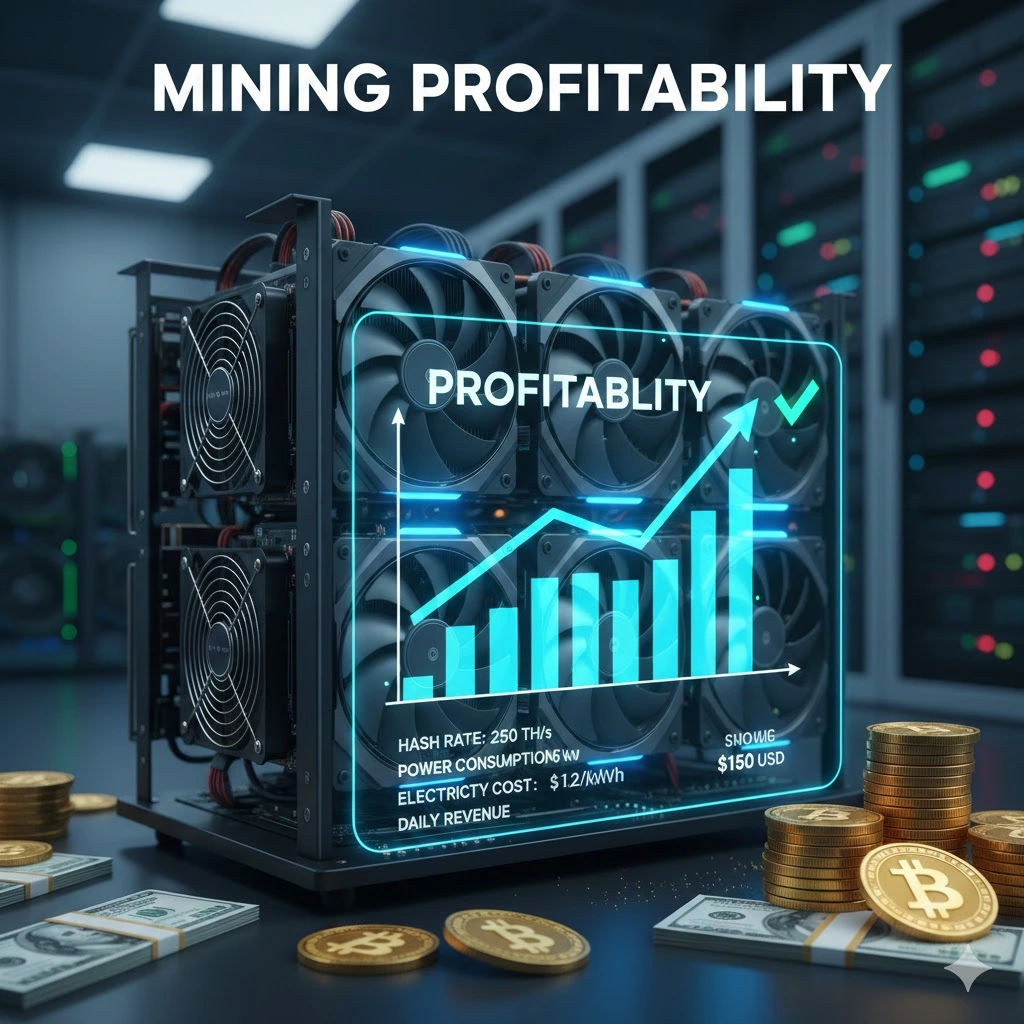
Thinking about getting into cryptocurrency mining in 2026? Before you invest thousands in hardware, you need to calculate whether it's actually profitable. In this guide, we'll show you exactly how to determine your mining ROI using our Mining Profitability Calculator.
Is Mining Still Profitable in 2026?
The short answer: It depends. Mining profitability in 2026 varies dramatically based on:
- Your electricity costs (the #1 factor)
- Hardware efficiency (ASIC vs GPU)
- Which cryptocurrency you mine
- Network difficulty trends
- Current crypto prices
Let's break down each factor and show you how to calculate your potential profits.
Quick Profitability Check
Before diving deep, try our calculator:
ASIC vs GPU Mining in 2026
The first decision: which type of mining hardware?
ASIC Mining (Bitcoin, Litecoin, etc.)
| Pros | Cons |
|---|---|
| 100-1000x more efficient than GPUs | Single algorithm only |
| Higher daily profits (if profitable) | $2,000-$15,000 investment |
| Set and forget operation | Very loud (70-80 dB) |
| Purpose-built for mining | Fast depreciation |
Best for: Miners with cheap electricity (<$0.08/kWh) and dedicated space.
GPU Mining (Ethereum Classic, Ravencoin, etc.)
| Pros | Cons |
|---|---|
| Mine multiple coins | Lower efficiency |
| Resale value for gaming | Requires more management |
| Quieter operation | Higher power per hash |
| Lower entry cost | Building rig complexity |
Best for: Hobbyists, those with existing GPUs, or uncertain about long-term commitment.
Learn more: What is an ASIC Miner?
Electricity Costs: The Make-or-Break Factor
Your electricity rate determines whether mining is profitable or a money pit:
Mining Profitability by Electricity Cost (Antminer S21, 200 TH/s)
| Electricity Rate | Daily Revenue | Daily Cost | Daily Profit | Monthly Profit |
|---|---|---|---|---|
| $0.03/kWh | $65 | $2.52 | $62.48 | $1,874 |
| $0.05/kWh | $65 | $4.20 | $60.80 | $1,824 |
| $0.08/kWh | $65 | $6.72 | $58.28 | $1,748 |
| $0.10/kWh | $65 | $8.40 | $56.60 | $1,698 |
| $0.15/kWh | $65 | $12.60 | $52.40 | $1,572 |
| $0.20/kWh | $65 | $16.80 | $48.20 | $1,446 |
| $0.30/kWh | $65 | $25.20 | $39.80 | $1,194 |
Based on BTC at $100,000. Use our calculator for current prices.
Electricity Rates by Region (2026)
| Region | Average Rate | Mining Viability |
|---|---|---|
| Kazakhstan | $0.03-0.05/kWh | Excellent |
| Russia | $0.03-0.06/kWh | Excellent |
| Texas, USA | $0.08-0.12/kWh | Good |
| Canada (Quebec) | $0.05-0.07/kWh | Excellent |
| China | Banned | N/A |
| Germany | $0.35-0.45/kWh | Unprofitable |
| UK | $0.25-0.35/kWh | Marginal |
| Australia | $0.20-0.30/kWh | Marginal |
Top Mining Hardware in 2026
Best ASIC Miners
| Model | Algorithm | Hashrate | Power | Efficiency | Price | ROI* |
|---|---|---|---|---|---|---|
| Antminer S21 Hyd | SHA-256 | 335 TH/s | 5,360W | 16 J/TH | $12,000 | 4 mo |
| Antminer S21 | SHA-256 | 200 TH/s | 3,500W | 17.5 J/TH | $8,000 | 5 mo |
| Whatsminer M60S | SHA-256 | 186 TH/s | 3,422W | 18.4 J/TH | $6,500 | 4 mo |
| Antminer L9 | Scrypt | 16 GH/s | 3,360W | 210 J/GH | $10,000 | 6 mo |
| Antminer KA3 | Blake2S | 166 TH/s | 3,154W | 19 J/TH | $7,000 | 8 mo |
ROI at $0.08/kWh electricity
Best GPUs for Mining
| GPU | Best Algorithm | Hashrate | Power | Efficiency | Price | ROI* |
|---|---|---|---|---|---|---|
| RTX 4090 | Ethash | 130 MH/s | 320W | 0.41 MH/W | $1,600 | 12 mo |
| RTX 4080 | Ethash | 100 MH/s | 250W | 0.40 MH/W | $1,200 | 14 mo |
| RTX 3080 | Ethash | 100 MH/s | 220W | 0.45 MH/W | $600 | 8 mo |
| RX 7900 XTX | Ethash | 95 MH/s | 280W | 0.34 MH/W | $900 | 11 mo |
ROI at $0.10/kWh electricity, mining ETC
Step-by-Step: Calculate Your Mining Profit
Step 1: Know Your Electricity Rate
Check your electricity bill for the exact kWh rate. Look for:
- Base rate
- Delivery charges
- Taxes and fees
Total rate = Base + Delivery + Taxes
Step 2: Choose Your Hardware
Decide between ASIC or GPU based on:
- Budget
- Space and noise tolerance
- Long-term commitment
- Which coins you want to mine
Step 3: Use Our Calculator
- Go to Mining Calculator
- Select GPU or ASIC mode
- Choose your hardware (or enter custom specs)
- Input your electricity rate
- Select the cryptocurrency to mine
- View your profitability projections
Step 4: Factor in Additional Costs
Don't forget:
- Cooling costs (especially for ASICs)
- Maintenance and repairs
- Pool fees (typically 1-2%)
- Hardware depreciation
- Taxes on mining income
Mining Pool vs Solo Mining
For most miners, joining a mining pool is essential:
| Factor | Pool Mining | Solo Mining |
|---|---|---|
| Income | Steady, small payments | Rare, large payments |
| Variance | Low | Extremely high |
| Minimum hashrate | Any | Need significant % of network |
| Recommended for | Everyone except large farms | Only massive operations |
Pool fees typically range from 1-3%, which is worth the steady income.
What About the 2028 Bitcoin Halving?
The next Bitcoin halving is expected around April 2028, reducing block rewards from 3.125 to 1.5625 BTC.
Historical Pattern After Halvings
| Halving | Short-term Effect | 12-Month Effect |
|---|---|---|
| 2012 | Revenue dropped 50% | Price up 9,000% |
| 2016 | Revenue dropped 50% | Price up 2,800% |
| 2020 | Revenue dropped 50% | Price up 700% |
| 2024 | Revenue dropped 50% | Price up ~100% (so far) |
Strategy: If you're mining for the long term, accumulate now while block rewards are higher. The halving typically triggers price increases that compensate for reduced rewards.
Mining vs DCA: Which is Better?
For many investors, DCA (Dollar-Cost Averaging) might be more practical:
| Factor | Mining | DCA |
|---|---|---|
| Initial cost | $2,000-$15,000+ | Any amount |
| Ongoing costs | Electricity, maintenance | Small trading fees |
| Technical knowledge | Required | None |
| Time commitment | Setup + monitoring | 15 min/week |
| Risk factors | Hardware, electricity, difficulty | Price only |
| Passive income | Yes (decreasing over time) | No |
Mining
- High upfront investment required
- Monthly electricity costs
- Hardware depreciation
- Technical setup needed
- Risk of hardware failure
DCA
- Start with any amount
- No ongoing costs
- No depreciation
- Simple and automated
- No technical risk
Calculate both options:
- Mining Calculator — for hardware ROI
- DCA Calculator — for accumulation strategy
Real-World Mining Examples
Example 1: Home Miner in Texas
Setup:
├── Hardware: Antminer S21 (200 TH/s)
├── Cost: $8,000
├── Electricity: $0.10/kWh
├── Mining: Bitcoin

Monthly Results:
├── Revenue: ~$1,950
├── Electricity: ~$252
├── Net profit: ~$1,698
├── ROI: 4.7 months
Example 2: GPU Miner in California
Setup:
├── Hardware: 2x RTX 4090
├── Cost: $3,200
├── Electricity: $0.22/kWh
├── Mining: Ethereum Classic

Monthly Results:
├── Revenue: ~$180
├── Electricity: ~$101
├── Net profit: ~$79
├── ROI: 40+ months (marginal)
Example 3: Industrial Operation in Kazakhstan
Setup:
├── Hardware: 100x Antminer S21 Hyd
├── Cost: $1,200,000
├── Electricity: $0.04/kWh
├── Mining: Bitcoin

Monthly Results:
├── Revenue: ~$325,000
├── Electricity: ~$15,000
├── Net profit: ~$310,000
├── ROI: 3.9 months
Common Mining Mistakes to Avoid
Ignoring Electricity Costs
Many new miners focus only on hardware specs. Electricity is typically 70%+ of operating costs.
Buying Old Hardware
Older ASICs have worse efficiency. A $2,000 "deal" on an S17 might never pay off.
Not Accounting for Difficulty Increases
Network difficulty rises as more miners join. Your share of rewards decreases over time.
Forgetting About Taxes
Mining income is taxable in most countries. Factor this into your profitability calculations.
No Exit Strategy
Have a plan for selling or repurposing hardware when it becomes unprofitable.
FAQ
Is Bitcoin mining profitable in 2026?
Yes, but only with electricity below $0.10/kWh and efficient hardware like Antminer S21 or newer. Use our Mining Calculator to check your specific situation.
How much does it cost to start mining?
ASIC mining: $2,000-$15,000 for hardware plus electricity costs. GPU mining: $500-$5,000 for a rig. Monthly electricity varies by location.
Which cryptocurrency is most profitable to mine in 2026?
Bitcoin remains the most stable choice for ASIC mining. For GPUs, Ethereum Classic, Ravencoin, and Kaspa are popular options. Profitability changes daily—use our calculator for current data.
How long does it take to break even on mining hardware?
With cheap electricity ($0.05-0.08/kWh), modern ASICs can break even in 4-6 months. GPUs typically take 8-14 months. High electricity areas may never break even.
Is GPU mining dead after Ethereum moved to Proof of Stake?
No, but it's less profitable. Miners switched to Ethereum Classic, Ravencoin, Kaspa, and other coins. Profitability depends heavily on electricity costs.
Should I mine or just buy Bitcoin?
It depends on your situation. If you have cheap electricity and technical skills, mining can be profitable. For most people, DCA (buying regularly) is simpler and has similar or better returns.
Conclusion
Mining in 2026 can still be profitable, but only under the right conditions:
Mine if you have:
- Electricity under $0.10/kWh
- Capital for efficient hardware
- Technical knowledge or willingness to learn
- Dedicated, ventilated space
- Long-term commitment
Consider DCA instead if:
- Electricity costs over $0.15/kWh
- Limited budget
- No space for noisy equipment
- Want passive investing
Ready to calculate? Use our free Mining Profitability Calculator to see your exact ROI.
Prefer simpler investing? Try our DCA Calculator to plan your accumulation strategy.
This article is for educational purposes only. Mining involves significant financial risks including hardware depreciation, electricity costs, and cryptocurrency price volatility. Always do your own research before investing.
Last updated: January 2026